

As stress awareness month draws to a close, for some, stress levels are on the rise. It’s a time when many students are preparing to submit assignments, and are revising for exams.
Students are finding that stress has become an everyday occurrence, just a part of being at university. Stress doesn’t just present when exams are around the corner.
With the cost of living, financial burden and academic pressures rising not to mention poor prospects after graduation. The predisposing factors for stress are prominent.
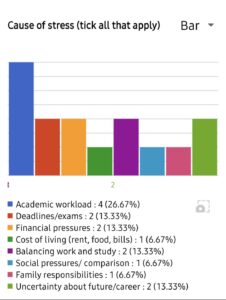
Research from the National Union of Students shows that financial concerns are one of the biggest causes for stress in students today. Students are balancing full time courses with part time work to keep themselves afloat.
https://www.mentalhealth.org.uk/explore-mental-health/cost-of-living/getting-support
The Mental Health Foundation have found that 31% of students are skipping meals to save money. 33% of students have considered dropping out of University due to financial constraints and 64% of full time students have a part time job to cope with rising costs.
Students are increasing having to choose between studying, working, home life, families and maintenance of good mental and physical health.
Postgraduate students especially are feeling the strain with tight deadlines and heavy workloads over short periods.
A postgraduate student said: “Sometimes I feel guilty if I am at home and not doing my university work.
“It’s difficult to get the balance right between university, work, home and keeping healthy.”
There is lingering feeling amongst students that they are ‘always on’ which only heightens their stress levels.
Whilst stress can be a motivator and encourage us to get things done, increased and continuous stress is not healthy.
Stress can cause mental and physical health problems and exacerbate existing conditions.
The Mental Health Foundation warns that ongoing stress can lead to burnout, anxiety, and depression. Their website has information for students on how to help themselves:
- Recognise when stress is a problem. Don’t ignore physical signs, headaches, migraines, tiredness. Work out what’s causing stress, sort your stressors, what can you do something about now? What can wait? Make a plan to control what you can, and set realistic expectations.
- Think about where you can make changes.
- Build supportive networks
- Eat healthily
- Be aware of your drinking and smoking
- Get some exercise
- Be kind to yourself
- Take time out
- Be mindful
- Get restful sleep
- Get professional help
At LJMU, students have access to student advice and wellbeing services who provide mental health advice, money support, counselling, and specialist support if required.
Like many universities these services are stretched, and students may be on a waiting list for some of these support mechanisms.
Stress management starts with encouraging students to recognise stress, adapt and utilise strategies and services to maintain their equilibrium.
Stress awareness month highlights to students what they can do to help themselves during challenging times.
For urgent mental health advice and support, please call your GP or NHS 111 (also available online at https://111.nhs.uk). You can also access urgent local support via this link: https://www.nhs.uk/nhs-services/mental-health-services/where-to-get-urgent-help-for-mental-health/