
By Elliana Hopwood and Tamsin Keeney
Liverpool welcomed the vibrant transition from the Year of the Snake to the Year of the Fire Horse with a period of traditional celebrations.
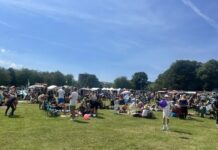
Firecrackers and bang snaps echoed through Nelson Street and Great George Square as hundreds gathered to watch Tai Chi demonstrations, choirs and traditional dancing.
Home to the oldest Chinatown in Europe, dating back to the 19th century, the city marked the beginning of the Lunar New Year with firecrackers, dances and guzheng melodies.
Nadia Anim, a dancer with Movema, said: “With Liverpool being one of the oldest Chinese communities in Europe, you really see how mixed families are, and it’s always lovely to see.”
Liverpool was gifted the largest Chinese arch outside of China in 2000, which stood over crowds cheering as the dragon weaved through shops and restaurants. This energetic tradition is believed to bless businesses and bring prosperity, luck and fortune for the year ahead.
On Saturday, the Victoria Gallery & Museum hosted a series of free events, including an exhibition of Chinese zodiac animals. It featured an interactive taxidermy rabbit, a snake skeleton and a horse skull.
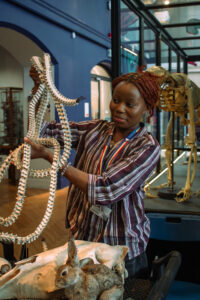
Yoana Nikolova and Hope Tsuma, exhibition staff, said: “Having skulls and taxidermies, something tactile, is important for education. Especially accommodating different learning styles and having that personal connection with things.”
Liverpool’s Chinese community has shaped the city for generations, first establishing itself in the 1860s through maritime trade routes. This connected Liverpool’s docks with ports in Hong Kong and Shanghai. Since then, the community has preserved cultural traditions despite hardships in the city.
Across the weekend, the festival’s heritage was reflected not only in its performances and music but also in the food, crafts, and a shared sense of community.
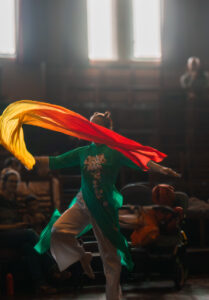
Movema, a world dance charity, held workshops over the weekend at Bluecoat and the museum. Children and families of all abilities participated, learning traditional chants and dance movements such as fanshen. Children dressed in traditional Chinese garments such as hanfu, qipaos and Tang jackets.
Nearby, dozens of stalls offered traditional crafts, including Chinese calligraphy, fan-making, and paper cutting known as Jianzhi.
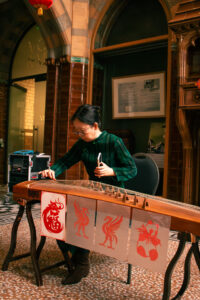
In the gothic galleries of the Tate Hall, a live performance on a guzheng filled the room with a soft, rippling melody. The guzheng originated over 2500 years ago in China and has 21 strings. It is plucked to create a unique sound of cascading water or rainfall.
Wenjie Wang, a visiting Mandarin volunteer, said: “The music’s rhythm is not like the Western one; there are five tones, unlike seven with the piano.”
The celebrations reflected both Liverpool’s long-standing Chinese heritage and the city’s ongoing commitment to cultural exchange within the community.
Rachel, a dancer who performed on Sunday, said: “It’s about sharing enthusiasm and love for community, family spirits, and camaraderie. It’s so important to share that love and energy with the community so everyone can feel that vibrance.”