

Campaigners have questioned whether Liverpool is a safe place for women to be at night after the city was once again recognised for its work to protect people after dark.
Liverpool retained its Purple Flag status, an accreditation that acknowledges work carried out to ensures safety in the city’s night time economy, for the 16th year in a row.
However, students and feminist campaigners say more must be done to ensure women and gender minorities feel safe when moving through the city at night.
Research carried out by the Merseyside Police and Crime Commissioner showed that 71% of women still live in fear of sexual assault.
Four in five women reported that poor or no street lighting made them feel unsafe.
These figures come alongside a government announcement that stated violence against women and girls is a national emergency.
Last year, students took to the streets at the Reclaim the Night march. This student-led movement was dedicated to raising awareness about the dangers women face in the evening and calling for safer public spaces.
Aimee Roy, Charity Officer for LJMU Pro-Choice Society said: “I attended the Reclaim the Night march, and for me it really highlighted how many women and students still don’t feel safe in Liverpool, despite awards like the Purple Flag.”
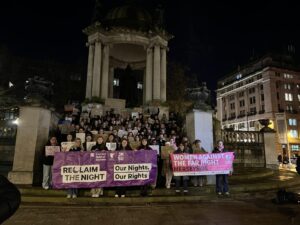
“Personally, I haven’t seen many visible changes being put into place that actually impact our day to day safety.”
“As students, we’re not just thinking about nights out, we’re also thinking about walking to work, going to the shop, or travelling home alone, and those concerns don’t disappear.”
Concerns were raised about the trust in authorities. A spokesperson for the University of Liverpool’s feminist society said: “When something goes wrong, they don’t feel safe turning to police or security staff for assistance”
She said there is still a gap between official safety recognition and the lived experiences of women and gender minorities.
Liverpool City Council has introduced several initiatives aimed at tackling violence against women and girls.
The Safer Streets programme introduced trained student volunteers to support people in Liverpool’s night time economy and expanded CCTV coverage on key evening bus routes used by young people.
The most recent initiatives, Operation Halo provided training for event security guards, bar managers, and taxi marshals. The training covers spotting signs of vulnerability, identifying repeat offenders, and responding to incidents.
Deputy president of the University of Liverpool’s student union Holly Thompson applauded Liverpool council for their work and dedication to improving safety.
She said: “The Purple Flag status is a positive step in the right direction. However, there is still a lot more to be done regarding safety both in Liverpool and across the UK.”
She said improvements should include better education within schools, harsher consequences for perpetrators, and greater support for victims.
In terms of the operation’s success she said: “I think it is too early to comment whether or not the operations have been successful, however I am glad that safeguarding training is having a focus and investment in.”
With more than 70,000 students studying in Liverpool, she said universities are a key part of the city’s night-time economy and safety strategy.
“In order to be the most effective in increasing safety across the city, all stakeholders, organisations and charities need to work together.”