


The number of male victims being referred for domestic abuse support has more than doubled in Liverpool.
The Paul Lavelle Foundation, a charity which raises awareness of male domestic abuse, has seen a 106% increase in referrals to their service since they began working with Liverpool City Council in January.
Mark Brooks OBE is the Chairman of the ManKind Initiative which supports male victims of domestic abuse in the UK.
He believes that the driving factors for the increase in referrals are better communication campaigns from local authorities and more men realising that domestic abuse does happen to them, so they are encouraged to come forward.
He said: “Sometimes you see in health systems and elsewhere where basically there were chances to identify male victims that were missed and because those professionals hadn’t really thought about the fact that men turning up with injuries or men feeling suicidal, men with depression, anxiety disorders or drinking alcohol, could be a victim of domestic abuse.”
Nearly 60% of men who call the ManKind Initiative helpline have never spoken to anyone before about the abuse they are suffering and 64% admit they would not have called the helpline if it was not anonymous.
Head of Education Studies and Psychology at LJMU, Angela Garden, worked as a counsellor and psychotherapist in the Probation Service at Rathbone Hospital.
She said: “Across both probation work and my hospital clinical experience, the strongest barriers I observed were shame, fear of not being believed, and internalised expectations to “cope alone.”
“Many men blamed themselves for the situation, or felt acknowledging harm undermined their identity.”
From her clinical roles, she found that male victims present differently to female victims.
She added: “This difference often reflects socialisation rather than the severity of harm.
“Women I’ve worked with tended to verbalise emotional impact more readily. Many men, by contrast, presented distress indirectly: through emotional numbing, withdrawal, or anger. ”
Her experience showed that when vulnerability feels unsafe, people default to protective behavioural responses rather than open disclosure.
Mark explained that it becomes a higher risk for men when they have what he calls “the three magnet issues” which keeps them in an abusive relationship.
This is marriage, a mortgage, and children and they are, therefore, at higher risk as they are less likely to leave their relationship.
Government research shows that younger people are more likely to be in an abusive relationship but have fewer financial and legal ties to their abuser.
When asked if males are less likely to be referred earlier, resulting in the high-risk referrals in Liverpool, he said the issue was that not enough men were coming forward.
He said: “The national government statistics show that broadly two in every five victims of domestic abuse are male.
“But we also know that, you know, less than 5% of victims who have been supported by domestic abuse services are male. So therefore, there’s more men, who are victims, than are being supported by the system.”
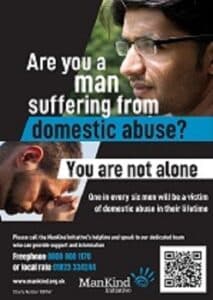
Between three to five men every single week die by suicide due to the domestic abuse they’re facing. ManKind’s research shows.
He added: “The challenge is often being that those suicides are not being picked up by coroners or by the police or by others as actually being domestic abuse related.
“So, one of the big research areas that ourselves and others are looking at is how to better identify suicide risk with regards to male victims of domestic abuse and have a better understanding of what the actual figures are.”
To reduce high-risk referrals of male victims and challenge stigma to encourage men to seek help sooner, the ManKind Initiative is running communication campaigns to encourage men to call their helpline.
They also have lots of information around domestic abuse to help men find a way to escape their abusive relationship.
For harder-to-reach or minority groups, Galop, a LGBTQ+ anti abuse charity, runs a national helpline for men in the GBT plus community.
Merseyside Police, the Liverpool City Council and the Paul Lavelle Foundation all run specialist campaigns aimed at men from different ethnic backgrounds, different sexualities, and those who are disabled.
Mark added: “Our aim of course, like others is to have zero domestic abuse, but obviously that’s not realistic.
“So even though we want to see the reduction in domestic abuse, we know that so many men are not coming forward.
“So, we want to see a reduction, but at the same time, far more men coming forward.”