

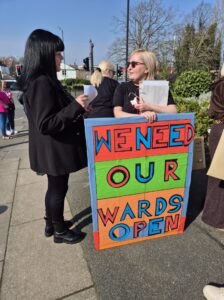
Campaigners from The Liverpool Hospice Action Group gathered outside the Marie Curie hospice in Woolton on Saturday to protest against the closure of its inpatient ward, warning the decision is leaving terminally ill patients without vital end-of-life care.
The demonstration brought together families, former staff, healthcare professionals and local residents, some holding photos of loved ones who had received care at the hospice.
The hospice’s inpatient beds are already closed. In their place, 12 temporary palliative care beds have been opened on the Maple Unit at the Liverpool Heart and Chest Hospital. However, campaigners say these are not a long-term solution, with the beds currently set to close in October 2026.
MAJOURN 25/26
Protesters say the loss of the original 26-bed unit has removed a crucial option for patients who cannot be cared for at home, placing additional strain on already stretched community services.
Campaigners argue that while community-based care plays an important role, reduced levels of support mean it cannot replace the specialist, round-the-clock care provided in a hospice setting.
Addressing the protest, Josie Mullen, Liberal Democrat councillor for Much Woolton and Hunts Cross, criticised what she described as an over-reliance on remote care.
She said: “What we are saying—and this needs to be communicated to the government and Marie Curie—is that virtuality, and having virtual support where you have the odd visit and the odd telephone call, is a way of dying in the upmost indignity.”
Among those attending was Richard Knights, a supporter of the Marie Curie Hospice Action Group.
He said: “Two or three years ago, a good friend of mine was dying of prostate cancer, and the care he had at Marie Curie was remarkable. He had a room on his own—it was really dignified—and you can’t always get that at the moment.
“With palliative care now, you’re often on a big ward with lots of people. Marie Curie is a really good facility, and it’s such a shame it’s been closed.”
Campaigners argue that while community-based care plays an important role, it cannot replace the specialist, round-the-clock support provided in a hospice setting.
The protest also featured live music from supporters, including Sandra Hamilton, who performs as part of the group Uketopia.
She said: “I think the enthusiasm today shows that the organisers of the Marie Curie Action Group are really going to keep going. I think change will come if there’s enough optimism, and if the people of Liverpool hear what’s going on and come out and support.”
Campaigners say the fight is far from over, calling for sustainable funding and a long-term solution for hospice care in Liverpool beyond 2026.