
Liverpool’s first-ever international jazz fringe festival will launch tomorrow night, promising to give a new platform to grassroots musicians from the city and beyond.
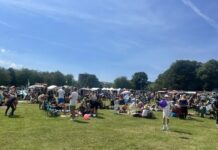
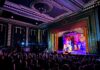
The festival opened with a preview gig at the Baltic Market on Saturday, and a further six events are scheduled over nine days. This includes performances by over 50 artists from Liverpool’s grassroots scene.
Jonathan Butters, Founder of the fringe said: “We’re a community sort of thing. And its multi-generation, multi-ethnic, multi-musical taste, multi-socioeconomic. Classically Liverpool, it’s a bit of everything.”
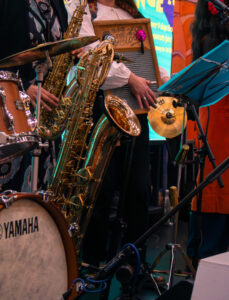
Three ensembles performed ahead of the upcoming opening night to give the community a taster of what’s to come. They covered genres such as all-vinyl analogue jazz, 1920s-inspired swing and virtuoso guitar fusion.
Bearcat Gumbo is a five-piece, all-female ensemble specialising in rich vocal harmonies and jaunty jazz, brought to life on double bass, washboard, piano, saxophone, and clarinet.
Speaking after the performance, bassist Parabhen explained the origins of their name. ‘Bearcat’ is an old jive term for a feisty woman, and ‘Gumbo’ is a traditional stew from New Orleans, fitting for the band’s energetic and sweet sound.
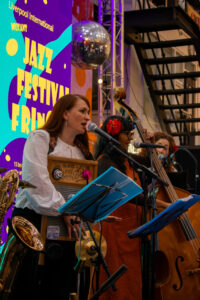
The band performed an emotive set of spirited cartoon classics and original numbers. She said the music was rooted in gospel and spiritual influences designed to uplift the listener’s soul.
Parabhen said: “I think the interesting thing about that era of music is that it was written in a time, which is quite similar to now, a time of great change. There was a whole lot of poverty and sadness in the world and people’s daily lives. And this music had a purpose. It was like a respite from that.”
The event saw artists like Bearcat Gumbo and DJ Copious Notes & DJ Jabjazz.
Jonathan, who founded and funded the event did so to create a sustainable platform for young jazz musicians. He designed it to complement the Liverpool International Jazz Festival by facilitating late-night performances showcasing local talent.
Jonathan said: “That’s really uniquely Liverpool, where there’s very much a grassroots understanding of culture. And not sort of ring-fencing it or ghettoising it. It’s really important.”
The emerging artists across the line-up include fusions of jazz, such as Chinese jazz fusion, contemporary soul and experimental quintets.
Liverpool’s history of jazz stretches back over a century, since sailors first arrived in the major port city from the United States in the 1920s. Bringing the sounds of New Orleans and Chicago, it became deeply rooted in local dance halls such as the Grafton Rooms on West Derby Road.
Jonathan reflected on Liverpool’s working-class cultural identity in jazz and the influence of the retired dock workers and their expansive knowledge on classical composers.
Guitarist Jack Taylor, who performed on Saturday, described the Liverpool audience as uniquely open.
He said: “There’s something about Liverpool, people just like music. It’s in their blood.”
Jack explained how jazz can carry a “weird reputation”, but live performances challenge that stereotype.
The Cavern Club, which has since become home to the rock and pop genres, originally opened as a jazz venue in 1957.
A revival swept the scene in 2012 when Ian Dixon first founded the Liverpool International Jazz Festival, bringing it back to the jazz culture of the area.
Jack said: “The boundaries are kind of what you want to make it. It’s not just a traditional 1940s thing anymore. It’s evolved.”
The main event’s opening night will be on the 26th of February at Hobo Pub with a line-up of improvisational jazz artists. Organisers hope the fringe festival will become a permanent fixture for the local music industry.